
Allied International Inc
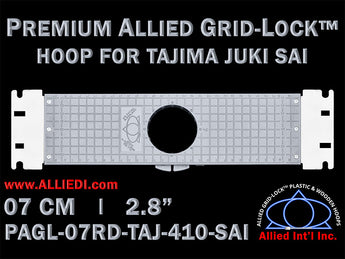
Tajima Juki SAI 7 cm (2.8 inch) Round Premium Allied Grid-Lock Embroidery Hoop for 410 mm Sew Field / Arm Spacing
Product Details
| Item # | |
|---|---|
| Inside Inner Dimensions (Y by X) | |
| Arm Spacing / Connector | 410 mm (16.1 inch) - Tajima Juki SAI |
| Hoop Thickness |
Couldn't load pickup availability
Product details
Add a short description for this section
Premium Allied Grid-Lock 7 cm (2.8 inch) Round Tajima Juki SAI Embroidery Hoop - 410 mm Arm Spacing
Great for monogramming, embroidering on pockets, baby garments and even socks
NOTE - Fits Tajima Juki SAI embroidery machine models. Does not fit standard Tajima commercial/industrial embroidery machine models.
Special features of Premium Allied Grid-Lock hoops which make them truly superior to competitor's hoops:
• Patented built-in horizontal and vertical grid lines enable quick and properly aligned hooping, every time!
• Save Time & Money and Eliminate Rejections! No more crooked embroidery!
• Extra-long 79 mm (3 1/8 inch) bolt-style adjustment screw is much easier to use and provides added hoop opening for thicker garments
• T and L markings on the tab of the hoop to show rotation direction of adjustment screw for Tightening and Loosening
Allied Grid-Lock hoops compared side-by-side against any competitor's hoops will out-perform and out-value, every time!
By using the patented built-in alignment grid lines & other features of Allied Grid-Lock hoops, you too can prevent garment rejections due to mis-aligned embroidery, as thousands of embroiderers have! You would realize real cost savings, significantly more than a small difference in the initial price of Allied hoops compared to other less-featured and lesser quality competitors’ hoops!
Want to save money again and again? Insist on using only Allied hoops, reputed as #1 hoops in features, quality and value!
For more product feature information, click the ALLIED HOOP FEATURES link above
To view other available hoops for your machine, please click the category tab for your machine brand
Please scroll down to view information on related replacement hoop accessory parts
Allied Grid-Lock™ (AGL / AGLC) and Premium Allied Grid-Lock™ (PAGL) Hoop Item Numbers
Examples of item numbers of AGL / AGLC plastic hoops: AGL-2430-SWF-400 / AGLC-15RD-TAJ-360
Example of item number of PAGL plastic hoops: PAGL-1920-MEL-400
Typically, Allied Grid-Lock hoop part numbers consist of 4 components, described below:
The 1st component has 3 - 4 starting letters. AGL / AGLC designates Allied Grid-Lock. PAGL designates Premium Allied Grid-Lock.
The 2nd component shows the “designated” hoop size in Y by X dimensions. This consists of 4 characters. In case of round hoops, the first two characters indicate the hoop diameter size in centimeters, and the last two characters are the letters RD for “Round” (e.g. 15RD for a 15 cm round hoop). In case of the square / rectangular hoops, the first two characters indicate the inside Y-axis dimension in centimeters, and the last two characters indicate the inside X-axis dimension in centimeters (e.g. 1920 indicates 19 cm in the Y-direction by 20 cm in the X-direction).
The 3rd component represents our abbreviated designation for the machine brand. In the above examples, SWF represents SWF brand machines whereas MEL represents Melco brand machines.
The 4th component indicates the Arm Spacing (AS) spec for which the hoops are designed to fit. For example, a 4th component of 400 represents the AS distance in millimeters required on the machine for that hoop to fit. Typical examples of AS specs (in millimeters): 360, 380, 394, 400, 460, 480, 495, 500, 504, 520, 605, etc. Most Grid-Lock hoops are available in multiple AS specs for each brand of machine.
Measuring Your Machine Arm Spacing (AS)
Arm Spacing (AS) refers to the distance between the embroidery machine pantograph arms which hold the embroidery hoops. To verify your machine's arm spacing distance, please measure the total width across an existing hoop including the metal brackets. This measurement would be slightly less than the pantograph arm spacing measurement. Arm Spacing is also sometimes referred to as "Embroidery Field" or "Sewing Field".
Example: For an embroidery machine with a listed sewing field of 360 mm (14.2"), the AS distance measured on the hoop may be about 355-356 mm (approximately 14.0”)
Here are a few tips for hooping that we have learned over time:
Start by finding the right hoop for the job. Try to use the smallest hoop possible for the job, however make sure that there is enough clearance for the presser foot. When possible, use a round hoop because this provides the most uniform grip and tension of the article being embroidered. Double-height hoops are useful for thicker fabrics as they provide more gripping surface. The natural grain of wooden hoops often provides a better grip on slippery fabrics such as satins and silks.
Use the proper backing for the fabric that you are embroidering on based on the material of the article and the complexity and weight of the design. If possible, use adhesive backing and apply the backing to the article before hooping. This will help keep a strong bond between the fabric and the backing, and will ensure that the backing is in the correct location and is providing proper coverage. This is especially helpful with stretchy fabrics to help prevent against overstretching the fabric while hooping. If it is not possible to use an adhesive backing, another tip is to place the backing on top of the outer ring, fold one corner of the backing over and around so that it reaches onto the inner wall of the outer hoop, and tape it in place to create an anchor point. Do the same on the opposite corner, and the backing should stay in place and have good tension.
To help prevent against hoop burn, place a piece of non-adhesive backing between the fabric and the inner hoop with a window cut out of the backing within which the embroidery will be done. You can make these liners ahead of time based on the size of the hoop(s) that you have and the available sewing area withing the hoop, and you can re-use these liners. For these, use a backing that won't transfer any color or residue onto the garment.
Adjust the outer hoop correctly before pressing in the inner hoop. The inner hoop should not go in very easily, nor should you have to press very hard. If the outer hoop is either too loose or too tight, remove the inner hoop and start over. Try not to adjust the outer hoop after inserting the inner hoop. It will take patience and practice to develop this technique.
Once the item is hooped, check for the tension of the material. If there isn't enough tension, re-hoop the item. Don't excessively pull on the fabric to remove any looseness, as this could lead to stretching of the fabric, distortion of the design and/or puckering.
- Building Blocks of Embroidery | Printwear Magazine, 03/03/2015, Ed Levy
- Hooping 101: Embroidery Basics | Printwear Magazine, 10/14/2014, Alice Wolf & Bonnie Nielson
- How to Hoop Difficult Fabrics | Printwear Magazine, 11/12/2012, Bonnie Nielson
- How to Hoop for Embroidery | Printwear Magazine, 03/15/2010, Bonnie Nielson
- How To Hoop Flawlessly | Printwear Magazine, 09/01/2008, Helen Hart Momsen
- Embroidery-specific stain removal | Printwear Magazine, 12/01/2007, Helen Hart Momsen
- Embroidery on Fleece | Printwear Magazine, 08/01/2009, Helen Hart Momsen
- Expand the Possibilities: Painting with Thread | Printwear Magazine, 11/01/2008, Helen Hart Momsen


%20Round%20Premium%20Allied%20Grid-Lock%20Embroidery%20Hoop%20for%20410%20mm%20Sew%20Field%20/%20Arm%20Spacing)